Chess Duels Review Tool
Turn post-game review into a short ritual: find the swing, name the blunder, then train the fix before you requeue.
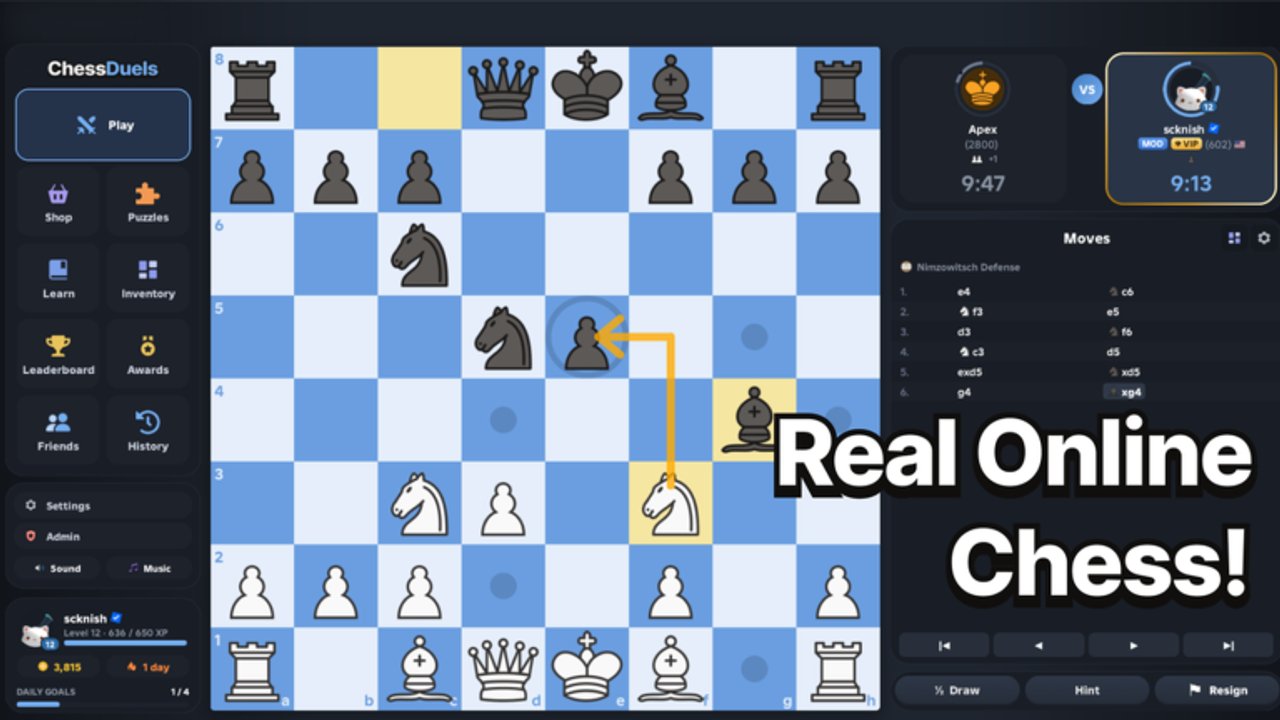
Chess Duels ships a post-game review tool that explains where a game turned—best moves, blunders, and plain-language lessons you can act on. Rated Bullet, Blitz, and Rapid will always teach under fire, but review is how you convert a loss into tomorrow’s win rate. This guide shows a practical ritual after losses, how to read best-move versus blunder callouts, how review differs by time control, when a light skim is enough, and how to feed mistakes into the 2000+ puzzle bank and lessons. Use it with Climb Rating, Puzzles and Lessons, Getting Started, Time Controls, Tools, and the Players Hub.
Why review beats instant rematch
Roblox chess queues are fast. The next opponent is one click away, which makes skipping review feel efficient and actually expensive. Without a named mistake, you repeat the same hang, the same bad trade, or the same flag panic. With a five-minute ritual, you leave the session smarter even if the rating graph dipped.
Chess Duels launched on 27 October 2026 (place 89083628291452) with review already part of the core loop alongside puzzles, lessons, daily goals, cosmetics, and the global leaderboard. Players who climb steadily treat review as non-negotiable after serious losses—and optional after gift wins.
What the review tool highlights
Exact UI labels can shift with patches, but the useful signal is consistent:
- Best moves / strong alternatives — moments where a cleaner idea existed. Save these when they match a plan you want to repeat.
- Blunders and critical errors — the swing points. These deserve names in your own words: missed hang, ignored check, wrong capture, panic trade, back-rank sleepiness, endgame technique fail.
- Explanations — short coaching text that turns engine-ish feedback into human next steps. Read them slowly once; do not skim past the sentence that hurts.
Your job is not to memorize evaluation numbers. Your job is to leave with one sentence you can train: “I hang pieces when I check-chase in Blitz,” or “I flag won rook endings in Rapid.”
The post-loss ritual (five to eight minutes)
Run this after every loss in your primary mode unless the game was a pure mouse slip you already understand.
- Open Review from the post-game flow (see panel layout tips on Tools if you lose the entry point).
- Find the first hard swing against you—or the moment you knew you blundered—even if later chaos looked worse.
- Name the error in plain language. If you cannot name it, you cannot train it.
- Classify the cause: opening knowledge, tactics, time management, or tilt.
- Assign the fix before requeueing:
- Opening → short lesson + two calm games later
- Tactics → ten themed puzzles from the catalog
- Clock → adjust spend rules for your mode
- Tilt → stop the session
Only after the assignment do you decide whether to play again. If the two-loss stop already fired, the assignment replaces rematch entirely. That rule is the spine of Climb Rating.
Light reviews after wins
Wins deserve less time. Spend one or two minutes asking:
- Did I win because of a repeatable idea or because the opponent hung a queen?
- Is there one move I want to remember?
Do not burn study energy congratulating yourself for gifts. Bookmark the nice idea, then protect focus for the next loss—which teaches more.
Linking review to puzzles and lessons
Review without training is journaling. Training without review is random gym work.
After a tactics blunder
- Note the theme (fork, pin, discovery, back rank, overloaded defender)
- Solve a short themed set from the 2000+ puzzles
- Optionally open a matching tactics or checkmate lesson
After an opening disaster
- Replay the first out-of-book fight in review
- Take the related opening lesson segment—not five unrelated courses
- Play the line again in Rapid when you have time to think
After a time scramble collapse
- Mark where your clock first became unhealthy
- Practice simpler decisions earlier in the next games
- Use puzzles for pattern speed if Bullet/Blitz is the climb mode
Full training schedules live in Puzzles and Lessons. Review is the triage desk that tells that guide what to load today.
Mode differences: Bullet, Blitz, Rapid
Review quality and ROI change with the clock. Details on mode personality also live in Time Controls.
Bullet
Expect more input errors, premove accidents, and flag finishes. Still review decision blunders (hanging a piece with time on the clock), but skip deep opening archaeology after every loss. A Bullet review might be ninety seconds: name the hang, solve five related mate/tactic flashes, decide whether the stop rule already applies.
Blitz
Best default for review volume. Games are rich enough that critical mistakes are real chess, yet short enough that you can review several per session. Prioritize the first swing and one conversion miss.
Rapid
Highest review value per game. You had time to think, so excuses shrink. Spend the full ritual. Rapid reviews pair especially well with lessons because you can execute the plan next game with a real clock.
If your primary ladder is Bullet, still play occasional Rapid for cleaner study samples—then return to Bullet volume with sharper patterns.
When to skip or shorten review
Skipping is allowed when honesty says the lesson is already obvious:
- Pure misclick in Bullet with no decision content
- Disconnect / leave situations with no chess to study
- Third review in a row when fatigue makes words bounce off the screen
Shorten—not abandon—when you are on a climb day and already reviewed two losses deeply. A thirty-second name-the-error pass still beats zero. Never use “I will review later” as a polite lie while the rematch button loads.
Session template that includes review
Warm-up
- Daily puzzle / light goals
- Eight catalog puzzles
Rated block
- Primary mode only
- Hard stop: time cap or two losses
Review block
- Full ritual on each loss
- Light skim on at most one win
- Immediate puzzle or lesson assignment if a theme repeats
Close
- Cosmetics browsing only after the chess work
- Check Players for inspiration on focused ladders—not for panic comparisons
New players should finish Getting Started so they know where Play, Puzzles, Learn, Review, and Customize sit before optimizing this loop.
Metrics that prove review is working
Over ten to twenty primary-mode games, track:
- Whether you can name the critical error without looking at the board again
- Whether the same theme appears less often the following week
- How often you actually completed the assigned puzzles/lessons
- How often you stopped instead of revenge-queuing
If rating rises but you cannot explain why, luck may be driving the sample. If rating is flat but your named errors are shrinking, keep the process—the graph usually follows.
Common review mistakes
- Only reviewing wins for dopamine
- Arguing with every best-move suggestion instead of extracting one actionable sentence
- Reviewing for twenty minutes, then playing angry Bullet anyway
- Ignoring mode context (treating a Bullet mouse slip like a Rapid calculation fail)
- Never opening puzzles after a tactics tag in review
Keep review tied to the rest of the wiki
- Climb process and tilt stops → Climb Rating
- Themed fixes → Puzzles and Lessons
- Clock behavior → Time Controls
- UI entry points → Tools
- Competition mindset → Players
- First-session orientation → Getting Started
The review tool does not raise rating by existing. You raise rating by using it when it hurts, naming the truth, and training the fix before the next queue. Make that boring ritual automatic and Chess Duels becomes a practice environment instead of a highlight reel of the same blunder. Play, learn, then review—every serious session.
Frequently Asked Questions
Quick answers to common Chess Duels questions.
Should I review every Chess Duels game?
Prioritize losses in your primary mode with a five-to-eight-minute ritual. Skim wins lightly; skip only obvious input slips you already understand.
What should I do right after the review tool flags a blunder?
Name the error, classify it (opening, tactics, clock, or tilt), then assign puzzles, a lesson, or a session stop before you requeue.
Does review work the same in Bullet, Blitz, and Rapid?
No. Rapid reviews dig deepest; Blitz is the best default volume; Bullet reviews stay short and focus on real decision hangs, not every premove accident.
Can the review tool replace solving puzzles?
No. Review finds the theme; the 2000+ puzzle bank and lessons train it. Use both in a loop with rated games.
Where do I open review if I cannot find the button?
Use the post-game flow after a match and check the Tools page for Play / Puzzles / Learn / Review / Customize panel orientation.